







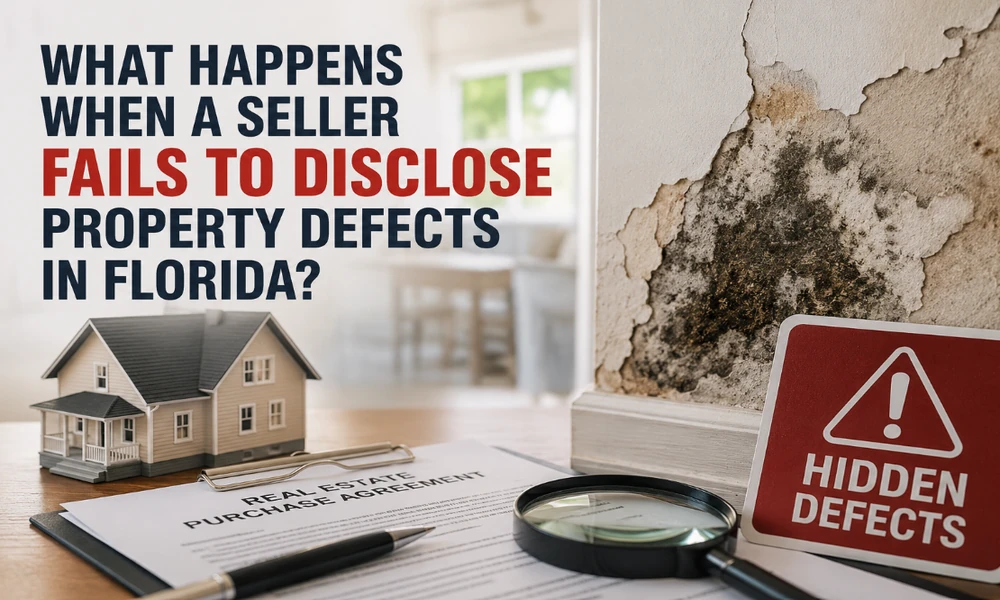
Buying a home in Florida is a big decision. Buyers often rely on inspections, property records, and information provided by the seller before agreeing to the purchase.
But sometimes a serious problem appears after closing.
Maybe the roof has a history of leaking. Perhaps there is hidden water damage behind a wall. There could be foundation movement, mold, plumbing trouble, or previous repairs that were never properly completed.
When a seller knew about a major property defect and failed to disclose it, the buyer may have legal options under Florida law.
What Must a Florida Home Seller Disclose?
Florida sellers generally have a duty to disclose facts that materially affect the value of residential property when those facts are known to the seller and are not readily observable or already known to the buyer.
This rule comes from the Florida Supreme Court decision in Johnson v. Davis. The case established that a residential seller cannot remain silent about a known, hidden defect that substantially affects the property’s value.
The defect usually must be more than a small cosmetic issue. It should be something important enough that it could affect a buyer’s decision, the price of the home, or the cost of owning and repairing it.
Examples may include:
- Recurring roof leaks
- Hidden mold or water intrusion
- Major electrical or plumbing problems
- Structural or foundation damage
- Termite damage
- Unpermitted additions or repairs
- Known sewer line defects
- Regular flooding or drainage problems
Florida law also specifically requires sellers to disclose known defects in a property’s privately owned sanitary sewer lateral before the sales contract is signed.
Does an “As Is” Contract Protect the Seller?
An “as is” contract does not automatically allow a seller to hide known defects.
The buyer may accept the property in its current condition and take responsibility for visible repairs. Still, the seller may remain responsible for failing to disclose a known defect that was hidden and materially affected the home’s value. Florida legal authorities have recognized that an “as is” provision does not erase this disclosure duty.
The buyer’s inspection rights are still important. Buyers should complete a careful inspection and investigate warning signs before closing.
However, an inspector may not find a defect that is concealed inside a wall, temporarily covered, or only appears during heavy rain.
What Must the Buyer Prove?
A buyer usually needs more than proof that the property has a defect.
The buyer may need evidence showing that:
- The seller knew about the problem.
- The problem materially affected the property’s value.
- The defect was not readily observable.
- The seller failed to disclose it.
- The buyer suffered financial harm.
Seller knowledge is often the hardest part to prove. Useful evidence may include earlier inspection reports, repair invoices, insurance claims, contractor records, emails, text messages, permits, photographs, or statements from neighbors.
Florida courts have also made clear that sellers should not be held responsible under this rule when they genuinely had no knowledge of the defect.
What Can the Buyer Recover?
The available remedy depends on the facts of the transaction.
A buyer may seek compensation for repair expenses, loss in property value, inspection costs, temporary housing, and other losses connected to the concealed defect.
Some cases may involve claims such as fraudulent concealment, fraudulent misrepresentation, negligent misrepresentation, or breach of contract. In serious situations, the buyer may ask the court to cancel the sale, although that remedy is not available in every case.
What Should a Buyer Do After Finding a Hidden Defect?
The buyer should document the condition before making major changes.
Take photographs and videos. Save the sales contract, disclosure forms, inspection reports, repair estimates, and communications with the seller. A qualified contractor or engineer may also help determine how long the defect existed and whether earlier repairs were attempted.
Buyers should act promptly because legal deadlines may apply.
A hidden defect does not always prove seller wrongdoing. Still, when evidence shows that a seller knew about a serious problem and stayed silent, Florida law may give the buyer a way to recover the resulting losses.
This post was written by a professional at Bonardi & Uzdavinis, LLP. Bonardi & Uzdavinis, LLP is a boutique, full service law firm providing its clients with a wide range of representation. Our primary areas of practice include sarasota foreclosure lawyer, probate, personal injury, construction, and commercial litigation. If you are looking for a real estate attorney or personal injury attorney in Tampa Bay contact us today for a case evaluation today!