

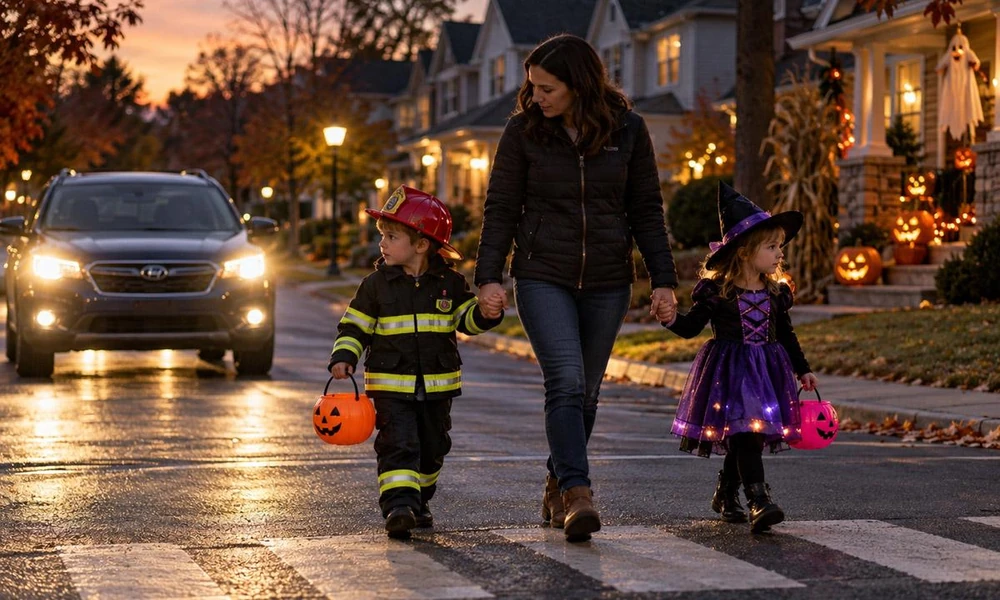




Halloween evening is one of the most dangerous times of the year for children on foot. A study in JAMA Pediatrics found that kids ages 4 to 8 were about 10 times more likely to be killed as pedestrians on Halloween evening than on other fall evenings. California law expects drivers to take extra care around children, and kids are judged by what is reasonable for their age. If your child is hurt, get medical care, document everything, and know that special rules protect children’s claims.
On Halloween evening, young children are about 10 times more likely to be killed as pedestrians than on other fall evenings. That finding, from a study published in JAMA Pediatrics, does not aim to scare anyone away from trick-or-treating. It reminds us that a Halloween pedestrian accident is one of the year’s most predictable and preventable dangers.
The absolute risk for any single child is still low. Millions of kids trick-or-treat every year and come home with nothing worse than a sugar rush. But when more children are on the streets than any other night, at dusk, in dark costumes, the numbers rise sharply.
This year, the timing is especially worth noting. Halloween 2026 falls on a Saturday, the last night before clocks fall back, with sunset in Orange County around 6 p.m. That means more kids out earlier, more parties, and more drivers on residential streets during the most dangerous hour.
Here is what every parent should understand: why the risk spikes, what drivers owe your kids, and what your family’s rights are if the worst happens.
Why Halloween Is So Dangerous for Kids on Foot
Halloween combines three risk factors: far more children walking than usual, the low light of dusk, and kids behaving in unpredictable ways. Research shows the deadliest hour is around 6 p.m., when rush hour, sunset, and peak trick-or-treating overlap. Young children ages 4 to 8 face the highest risk.
The JAMA Pediatrics researchers looked at decades of U.S. traffic deaths and compared Halloween evenings with nearby evenings in the weeks before and after. Overall, pedestrian deaths were notably higher on Halloween, and the jump was most dramatic for young children. A Washington Post analysis of federal data reached a similar conclusion, finding that the 6 p.m. hour stood out as the most dangerous.
It is not hard to see why. Costumes are often dark and masks can block a child’s side vision. Kids dart between parked cars to reach the next porch. Excited children cross mid-block instead of at corners. And many drivers are rushing home from work or heading to parties as the light fades.
Orange County neighborhoods add their own challenges. Popular trick-or-treat areas, from the tree-lined streets of Old Towne Orange to the village neighborhoods of Irvine and the walkable blocks of Huntington Beach, draw crowds from outside the neighborhood. That means more cars circling, parking, and pulling out at the same time children are crossing.
What California Law Expects From Drivers on Halloween Night
California drivers must always use reasonable care, and what counts as “reasonable” depends on the conditions. On Halloween, when children are known to be out in large numbers, drivers are expected to slow down, watch carefully, and anticipate kids stepping into the street.
The basic rule is simple: everyone must use ordinary care to avoid injuring others. Under Vehicle Code section 21950, drivers must yield to pedestrians in crosswalks, including unmarked crosswalks at intersections, and must slow down or take other actions to keep pedestrians safe.
That duty does not disappear when a child crosses outside a crosswalk. Even then, California law still requires drivers to use due care. Courts and juries also recognize that drivers should expect children to act like children, especially on nights when everyone knows kids will be out.
In practice, a driver who speeds through a crowded residential street at dusk on Halloween, looks at their phone, or drives after drinking at a party is in a poor position to argue they could not have avoided a child. The circumstances raise the standard of care.
Can a Child Be Blamed for a Pedestrian Accident?
California does not judge children by adult standards. A child is generally measured against what a reasonably careful child of the same age, intelligence, and experience would do. Very young children are rarely found meaningfully at fault, though insurance companies may still try to argue it.
This principle appears in California’s official civil jury instructions, published by the Judicial Council of California as CACI 403. It reflects common sense. A six-year-old in a superhero costume does not have the judgment of an adult, and the law does not pretend otherwise.
That has not stopped insurers from trying. After a Halloween crash, adjusters may argue the child “ran out of nowhere,” was wearing a dark costume, or was not being supervised. They may also try to shift blame onto the parents. These arguments are designed to reduce what the insurer has to pay, not to find the truth.
California’s comparative fault rule means that even if some fault were assigned to a child, the driver’s share would still be paid. And in many cases involving young children, those arguments do not hold up once we closely examine the driver’s speed, attention, and conduct.
On Halloween night, every driver knows children will be in the street. The law expects them to drive that way.
What to Do If Your Child Is Hit on Halloween
If a car hits your child, get emergency medical care first, then call police and make sure they file a report. Gather witness information and save video from nearby homes, since porch and doorbell cameras are everywhere on Halloween. Avoid discussing fault with the driver or their insurer.
In the moment, your only focus should be your child. Call 911, and even if your child seems okay, have them examined. Head injuries in particular can be subtle at first, and children may not be able to describe what they feel.
Once your child is safe, the evidence becomes important, and Halloween creates an unusual advantage. More homes than ever have doorbell and porch cameras, and on Halloween, neighbors are often outside recording their kids. The challenge is that this footage is often recorded over within days. This scenario is the one place a checklist helps:
- The police report number and the names of responding officers
- Names and phone numbers of witnesses, including other parents and neighbors
- Doorbell, porch, and security camera footage from nearby homes
- Photos of the scene, lighting conditions, and where the car stopped
- Your child’s costume, including any reflective tape or lights
- All medical records, bills, and notes about your child’s symptoms
Do not apologize, guess about what happened, or give a recorded statement to the driver’s insurance company. You can politely say you will follow up later.
How Claims Work When the Injured Person Is a Child
Claims for injured children follow special rules in California. Children generally get extra time to file a lawsuit, but parents’ claims for medical bills follow the normal two-year deadline. Any settlement for a minor usually needs court approval, which protects the child’s money until they become an adult.
Under Code of Civil Procedure section 352, the deadline for a child’s own injury claim is generally paused until they turn 18. But that extra time does not apply to everything. Parents’ claims for the medical expenses they paid generally follow the standard two-year deadline under section 335.1, and claims against a government agency have much shorter deadlines. Waiting is rarely wise, because evidence fades fast.
When a child’s claim settles, California generally requires a judge to approve the settlement through a process often called a “minor’s compromise,” governed in part by Probate Code section 3500. The court reviews whether the settlement is fair and makes sure the money is protected, often in a blocked account or structured payments, until the child is an adult.
Children’s injury claims also look further into the future. A broken leg, a traumatic brain injury, or scarring can affect a child’s growth, schooling, and life for years. Those future costs should be part of any claim. Our brain injury attorneys understand how these injuries can unfold over time.
Keeping Halloween Safe and Knowing Your Options If It Isn’t
Most Halloween nights end safely, and a few simple habits make a real difference: brighter costumes, a flashlight for every child, crossing at corners, and an adult with young kids. If a careless driver still causes harm, your family has rights, and you do not have to face the insurance company alone.
Safety experts, including the National Highway Traffic Safety Administration, recommend a few practical steps. Add reflective tape or glow sticks to costumes. Choose face paint over masks that block vision. Give every child a flashlight. Walk on sidewalks, cross at corners, and teach kids to make eye contact with drivers before crossing. For young children, an adult should always be along.
If you are driving that night, slow down in neighborhoods, put the phone away, take extra care backing out of driveways, and never drive after drinking. If you are heading to a party, plan your ride home before you leave.
And if the worst happens, remember that the law recognizes what everyone already knows: children will be children on Halloween, and drivers are expected to adjust.
The Bottom Line
The numbers behind Halloween are sobering, but they are also a roadmap. Most of the danger comes from predictable conditions: dusk, crowds, and distracted or impaired drivers. A little preparation goes a long way, and the law places real responsibility on drivers to watch for kids.
If your child was hurt in Irvine, Huntington Beach, Anaheim, or anywhere in Orange County or the Inland Empire, our personal injury team is here to help your family focus on healing.
Been in an accident or hurt on the job? You don’t have to navigate insurance companies alone. Oracle Law Firm fights to get you the compensation, control, and clarity you deserve.
Get a Free Consultation or call 888.597.4099.
Disclaimer: This article is for general information only and is not legal advice. Reading it does not create an attorney-client relationship. Every case depends on its own facts, and past results do not guarantee future outcomes. For advice about your situation, speak with a licensed California attorney.
Frequently Asked Questions
Why is Halloween so dangerous for child pedestrians?
Halloween puts far more children on the street than usual, at dusk, often in dark costumes and masks that limit vision. A study in JAMA Pediatrics found children ages 4 to 8 were about 10 times more likely to be killed as pedestrians on Halloween evening than on other fall evenings, with the 6 p.m. hour among the most dangerous.
Who is at fault if a car hits a trick-or-treater?
Fault depends on the facts, but California drivers must use reasonable care, and on Halloween that means watching closely for children. Children are judged by what is reasonable for their age, not adult standards. Drivers who speed, are distracted, or are impaired are often found responsible.
Can my child be blamed for being hit by a car?
California judges children by the standard of a reasonably careful child of the same age, intelligence, and experience. Very young children are rarely found meaningfully at fault. Even if the court assigns some fault, California’s comparative fault rule still allows recovery for the driver’s share.
How long do I have to file a claim if my child was hit by a car?
A child’s own injury claim generally has extra time, because the deadline is usually paused until age 18. However, a parent’s claim for medical bills generally must be filed within two years, and claims against government agencies have much shorter deadlines. It is best to speak with a lawyer early.
Does a court have to approve a settlement for an injured child?
Usually, yes. California generally requires a judge to approve settlements for minors through a process called a minor’s compromise. The court reviews whether the settlement is fair and makes sure the money is protected until the child becomes an adult.